
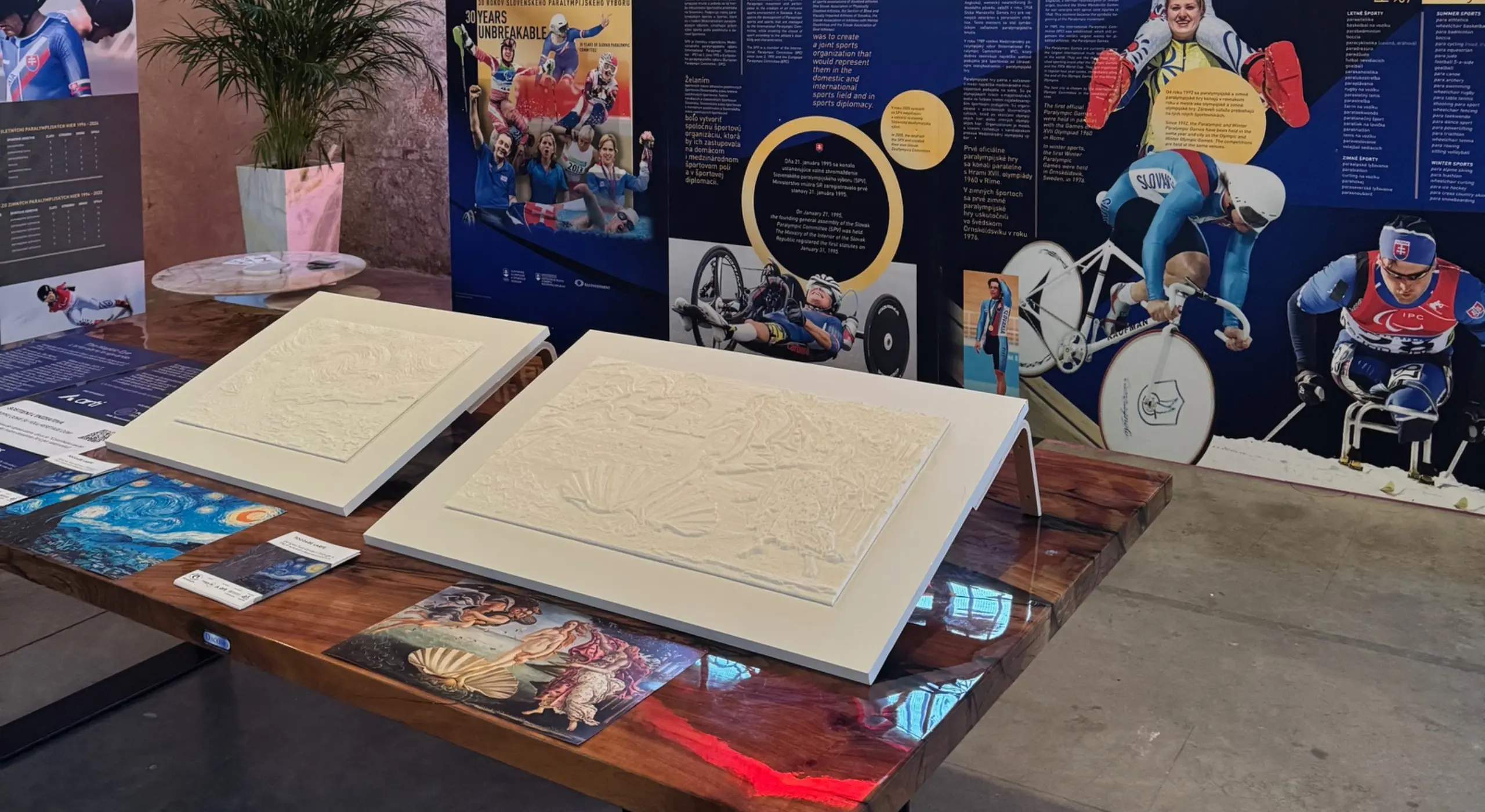
The exhibition “Art Through Touch: From Painting to Sculpture with Artificial Intelligence” presents an innovative journey dedicated to cultural accessibility, in which art, digital technologies, and social inclusion converge into a single experience. The project consists of tactile three-dimensional portraits of well-known figures, accompanied by audio descriptions, and was created with the aim of making visual heritage accessible through touch as well, offering new ways of engaging with artworks for people with visual impairments and, more broadly, for all visitors.
The initiative stems from research carried out in the field of digital representation and physical prototyping. In its initial phase, paintings were translated into tactile panels using software capable of analyzing light and shadow and converting them into bas-reliefs. This approach already represented an important mediation tool, as it allowed certain volumetric elements of the image to be perceived. However, it did not fully convey the depth, three-dimensionality, and formal complexity of the faces depicted.
The introduction of artificial intelligence marked a fundamental step in the project’s evolution. Thanks to advanced processing systems, it is now possible to start from a simple two-dimensional image and obtain a three-dimensional model capable of interpreting its volumes more completely. A self-portrait by Van Gogh, a painting by Leonardo, or the face of Frida Kahlo can thus be reworked by AI and transformed into digital sculptures, later produced through 3D printing and, where necessary, refined through milling processes. The result is a tangible physical object, one that can be explored by hand and offers a richer experience than the simple tactile reading of a raised surface.
Each work takes shape within a PLA filament, a material used in 3D printing, and is developed from a photograph or image that is selected and digitally reworked. In this process, the transition from 2D to 3D represents not only a technical advancement, but also a cultural shift: the image is no longer only observed, but can also be read, interpreted, and understood through manual exploration. In this way, the exhibition gives new materiality to iconographic heritage, translating the visible into a concrete and accessible form.
Among the pieces produced, the bust of Salvador Dalí is a significant example: its production required approximately 13 hours of printing and around 30 meters of PLA. Alongside major figures from the history of art, the exhibition also includes personalities from the worlds of science and sport, such as Marie Curie, Isaac Newton, Sofia Raffaeli, and Roger Federer. This choice broadens the educational value of the project and makes it possible to propose a cross-disciplinary narrative capable of bringing together different fields, languages, and audiences.
A particularly important aspect of the initiative is its educational and participatory dimension. The project involved university students from the bachelor’s degree programs in Industrial Production Engineering (IPI) and Interaction Design, as well as students from the master’s degree in Mechanical Engineering – Sport Engineering track. They were joined by middle school students, who took part in a technical and creative exploration workshop. This experience made it possible to combine formal education with concrete project-based activity, enhancing both the acquisition of technical skills and awareness of accessibility and inclusion.
Through activities involving 3D modeling, additive manufacturing, and augmented reality, students were able to follow all stages of the artwork’s development: from preparing the file for 3D printing to checking the model’s quality, from identifying errors and imperfections to understanding materials and the extrusion process. They also experienced firsthand how a simple image found online can be transformed, through AI, into a digital prototype and then into a physical sculpture with cultural, educational, and social value.
Since March 6, the exhibition has been on display with a selection of tactile works at Casa Verona, the space designated by the Municipality of Verona to narrate the Olympic journey, where sport, culture, and community come together. This presence represents an important opportunity for public engagement and practical experimentation, placing the project within a context of strong symbolic and territorial value.
To complete the experience, an augmented reality application has also been developed, enabling the audio description associated with each represented figure to be activated. This tool expands the ways in which the exhibition can be experienced, integrating touch, listening, and digital content into a multisensory experience. The project therefore stands as a concrete example of innovation applied to cultural heritage, demonstrating how emerging technologies can foster new forms of access, participation, and inclusion.
This project was coordinated by Prof. Mario Covarrubias Rodriguez