Paralympic alpine skiing allows athletes with lower-limb disabilities to compete at high level using a sit-ski, a device that combines a seat mounted on a suspension system fixed to a single ski. While the sport shares many similarities with traditional alpine skiing, the absence of functional legs fundamentally changes how forces are managed, how turns are performed, and how vibrations are transmitted to the body.
In able-bodied skiing, the legs play a crucial role. They absorb terrain irregularities, control balance, regulate pressure on the skis and help generate propulsion during turns. In sit-skiing, these biomechanical functions must be replaced by mechanical components, primarily the suspension system positioned between the seat and the ski. This makes the interaction between athlete and equipment even more critical for both performance and comfort.
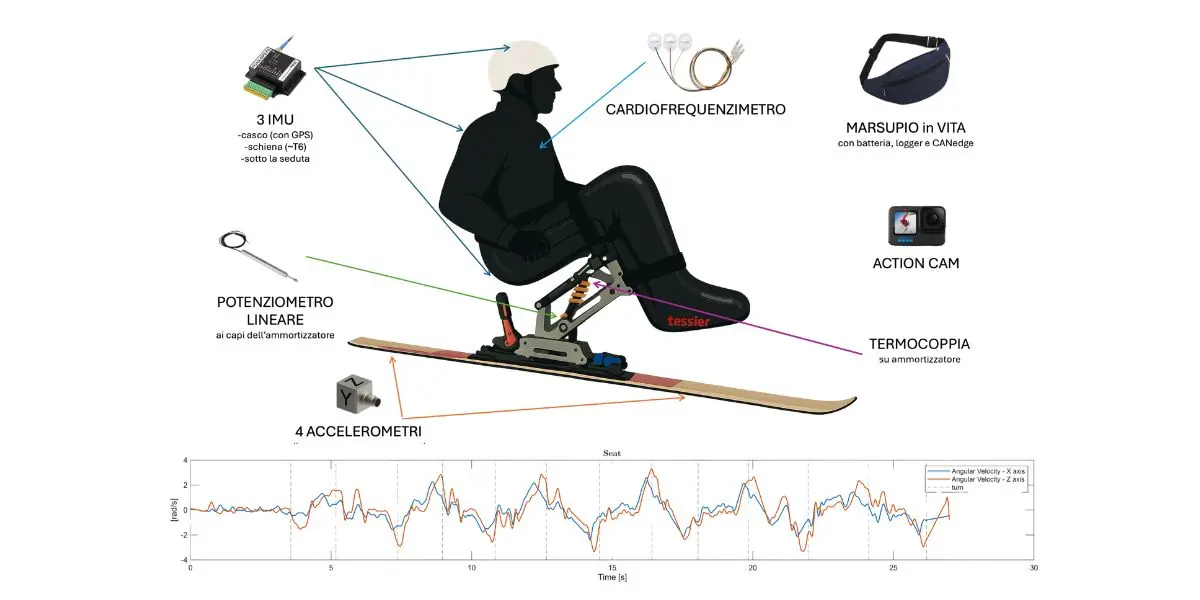
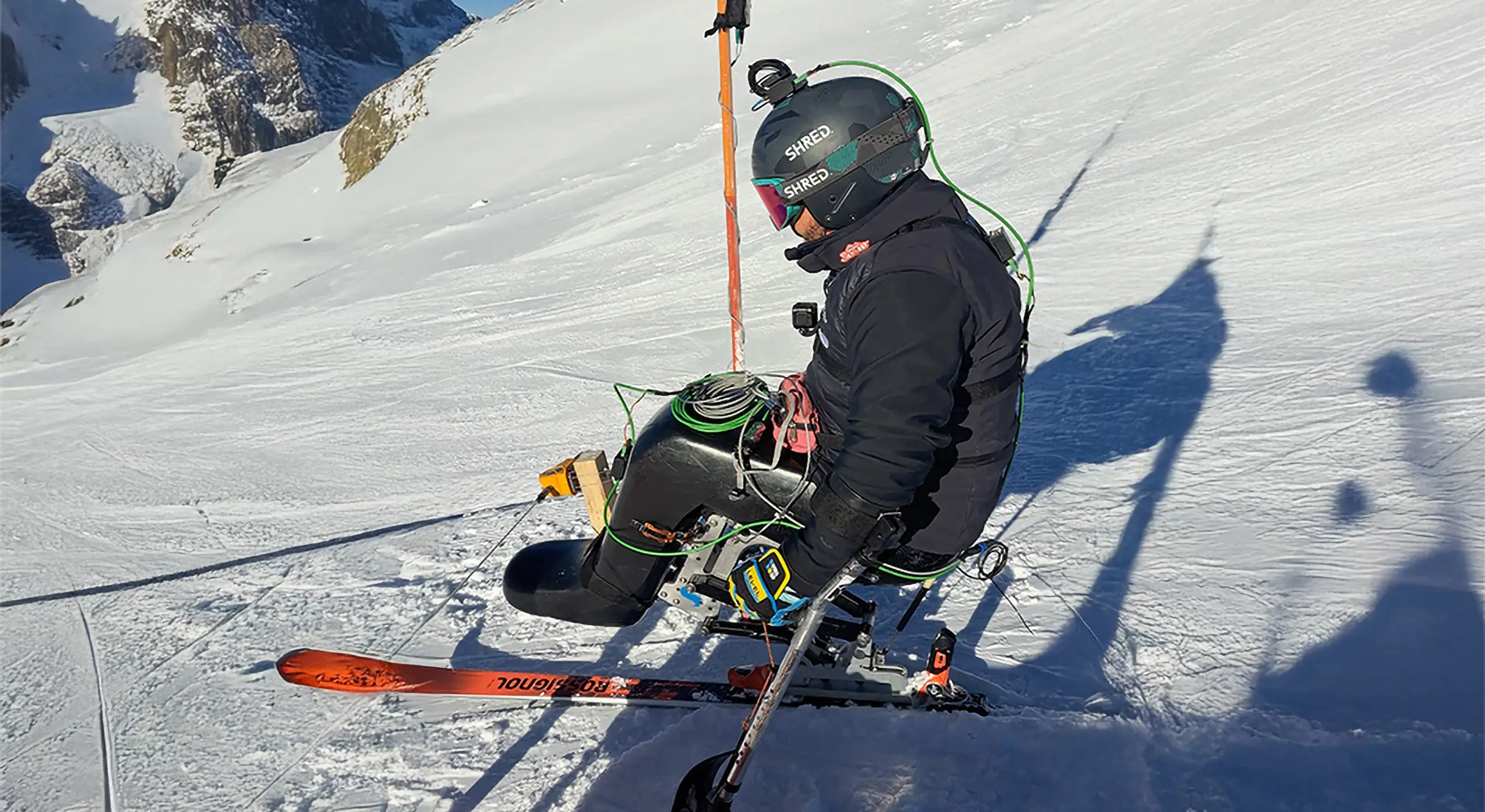
We have investigated this interaction through a combination of on-slope measurements, laboratory experiments and computer simulations. Field tests were conducted during real training sessions, equipping the athlete and the sit-ski with motion sensors, displacement sensors and a GPS system. These instruments recorded accelerations, movements and suspension behavior during descent. The goal was to understand how vibrations generated by the ski and terrain propagate through the device to the athlete’s trunk and head.
To better isolate and understand the mechanical behavior of the system, laboratory tests were also performed. The ski dynamic characteristics, such as natural frequencies and vibration modes, was identified by measuring its acceleration response to impulse excitation with an impact hammer. In addition, vibration transmission to the human body was studied using a vibrating platform under controlled conditions. Different postures and the use of ski poles were examined to evaluate how body configuration influences vibration absorption.
The collected data supported the development of a biomechanical simulation model representing both the human body and the mechanical structure of the sit-ski. The human body was modeled as an equivalent lumped parameter mechanical system composed of masses, springs, and dashpots, as well as done for the suspension which was represented as aspring–damper system. This approach made it possible to reproduce and analyze how forces and vibrations travel through the combined athlete–device system.
One of the key findings concerns the delicate balance required in suspension tuning. If the suspension is too stiff, it may transmit excessive accelerations to the athlete. If it is too soft, instability and unwanted oscillations may occur, especially during rapid transitions between turns. Athletes therefore require adaptable systems capable of responding differently to slow, progressive loads and sudden impacts.
This research highlights the importance of a user-centered design approach in adaptive sports equipment. Comfort, safety, and performance are deeply interconnected, particularly for athletes with spinal injuries who may be more sensitive to vibration and cold. By combining biomechanics, experimental testing, and simulation, the study contributes to improving sit-ski design and supports the broader goal of making high-performance sport more inclusive and accessible.
The research team for this project includes Marta Gandolla, Michele Vignati, Mattia Belloni, and Giulia Anghileri, whose master’s thesis focused on this topic.