
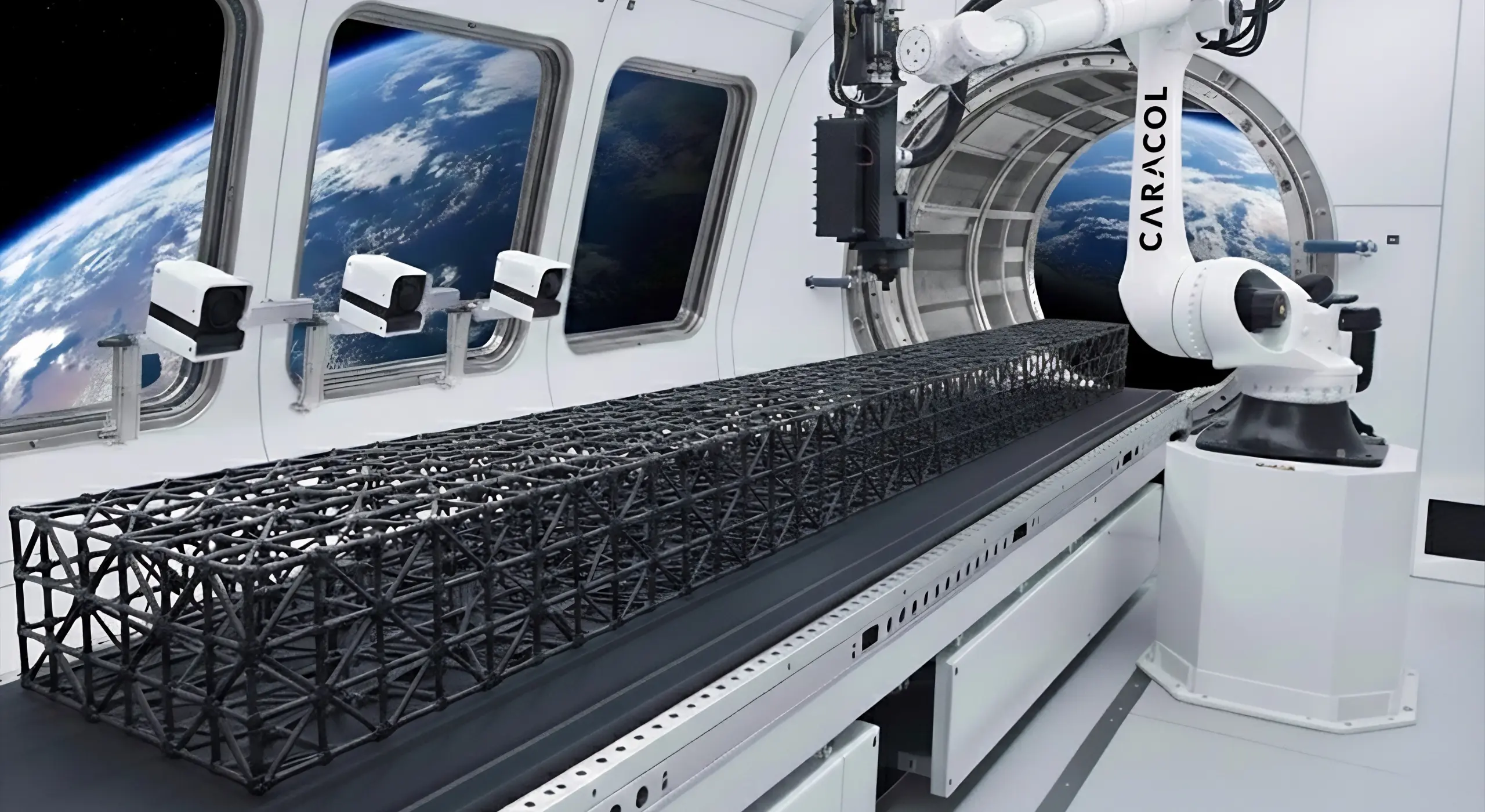
The AIMIS LFAM project (AI-Based Monitoring of Large Robotic Format Additive Manufacturing in Space) is funded by the European Space Agency (ESA) and involves a collaboration between three partners: Caracol , project coordinator, Politecnico di Milano, and Obo Space. The aim is to lay the technical and programmatic foundations for the development of intelligent and autonomous infrastructures dedicated to large-scale 3D printing in space.
The AIMIS LFAM project explores the feasibility of innovative off-Earth monitoring and control methods for additive manufacturing processes using LFAM technology, leveraging the synergy between the capabilities enabled by Additive Manufacturing and new Artificial Intelligence (AI) solutions.
The Department of Mechanical Engineering at Politecnico di Milano, and in particular the research group led by Prof. Bianca Maria Colosimo with the involvement of Prof. Marco Grasso, contributes through the development and ground testing of in-situ monitoring technologies that combine real-time acquisition of complex data with AI techniques for the autonomous identification of defects and anomalies.
The research aims to assess risks and related mitigation strategies, requirements, and application scenarios for the development of intelligent and adaptive manufacturing infrastructures in space. These systems are envisioned to operate fully autonomously in Earth orbit or on the lunar surface, producing fit-for-purpose, defect-free parts while minimizing the amount of material and equipment launched from Earth.
The new space economy is opening up radically innovative scenarios, driven by increasing private sector involvement, reduced launch costs, and the need for sustainable solutions for space exploration and long-duration missions. In this context, in-space 3D printing emerges as an enabling technology of extraordinary impact.
The combination of technologies such as LFAM with advanced monitoring and control methods represents a key pillar for the development of the new space economy, supporting long-term missions and sustainable colonization.
The AIMIS LFAM project marks a first critical step in this direction.
The team of the Department of Mechanical Engineering involved in this project includes Prof. Bianca Maria Colosimo and Prof. Marco Grasso.