
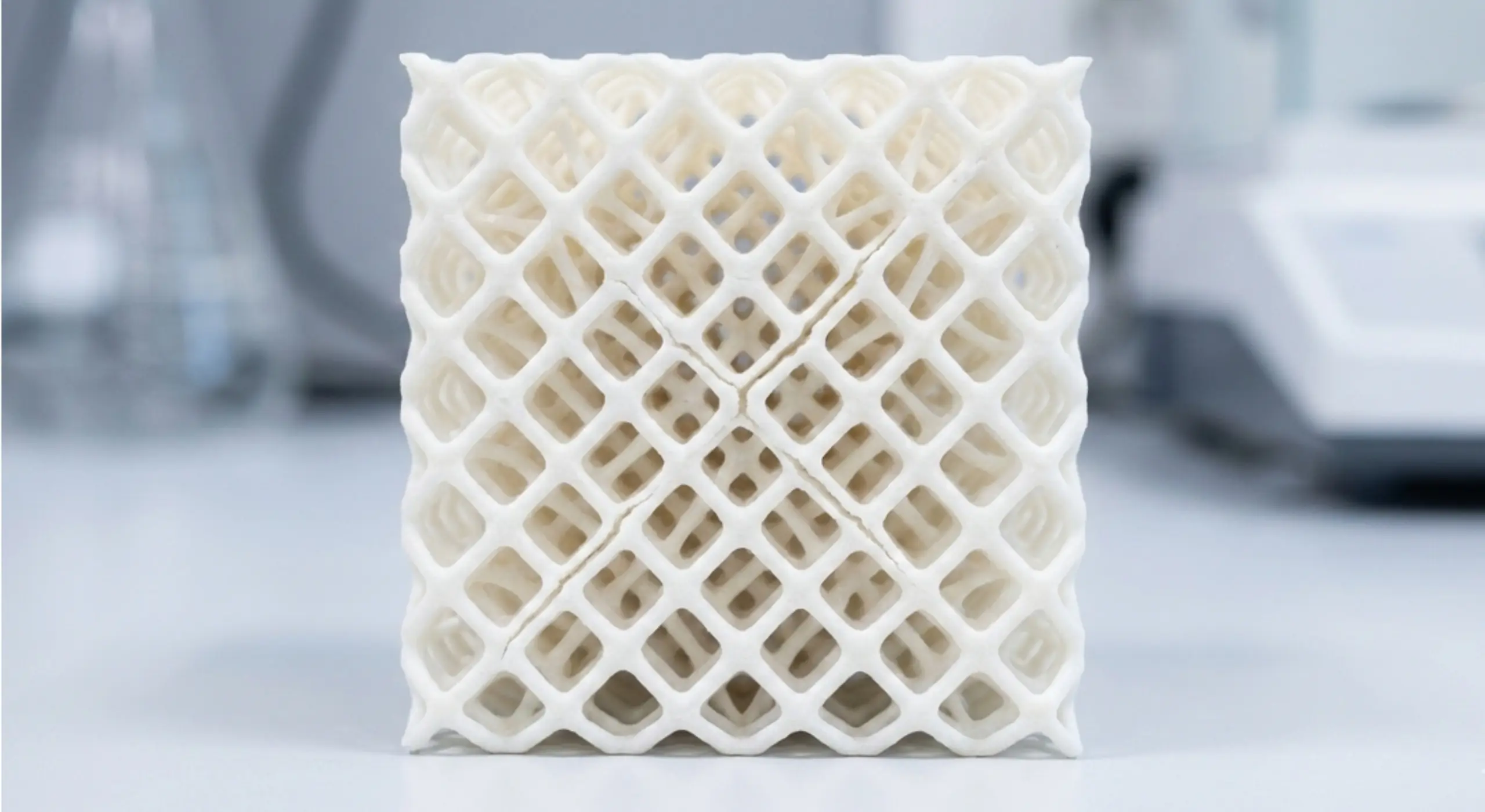
Lightweight, highly customizable, engineered to deliver mechanical properties far beyond those of conventional materials. Artificial metamaterials are widely regarded as one of the most exciting frontiers in modern engineering. Complex architectures, smart lattices, and tailored geometries allow researchers to tune stiffness, energy absorption, and impact response with unprecedented precision.
But what happens when these sophisticated structures suddenly fail?
The answer is less reassuring than expected. Several metamaterial prototypes have shown a tendency toward abrupt and catastrophic failure. These are not minor, controllable microcracks, but rapid fractures that are difficult to predict and costly to manage. In sectors such as aerospace, automotive, and biomedicine, long-term reliability is not optional, it is essential. Unexpected failure means higher maintenance costs, premature replacement, and significant sustainability concerns.
The challenge is not only technological, but methodological. Metamaterials are hierarchical systems: their global behavior depends on phenomena occurring across multiple scales, from the microscopic to the structural level. Traditional computational and experimental tools often struggle to capture this complexity. How can fracture initiation be predicted in such intricate architectures? How can damage evolution be simulated when multiple mechanisms interact across different length scales?
This is where IDEM project (“nature-Inspired Damage-resistant Engineered adaptive Metamaterials”) comes into play, funded by the Italian Science Fund (FIS3 Starting Grant) and coordinated by Federica Buccino, Researcher at the Department of Mechanical Engineering at Politecnico di Milano, within the research group of Professor Laura Vergani, a leading expert in fracture mechanics.
The FIS3 Starting Grant, promoted by the Italian Ministry of University and Research, is among the most competitive national funding schemes for fundamental research. Selection is based on rigorous peer review and strict criteria of scientific excellence, originality, and potential impact.
The core idea is both ambitious and radical: learning from Nature to anticipate and manage damage. Biological materials such as bone and nacre have coexisted with defects and mechanical loads for millions of years without collapsing suddenly. They do not eliminate damage, they control it. They distribute it across scales, deflect cracks along less critical paths, and slow fracture propagation through cooperative mechanisms combining mechanical, microstructural, and sometimes chemical effects.
IDEM seeks to translate these principles into engineering solutions. The goal is not simply to make metamaterials stronger, but smarter, capable of adapting, redistributing stresses, and governing fracture evolution rather than passively enduring it.
To achieve this, the research integrates adaptive multiscale digital models that evolve together with the material, alongside probabilistic approaches to quantify uncertainty and intrinsic variability. These are coupled with experimental validation driven by real-time imaging techniques, enabling researchers to observe crack initiation and propagation across multiple scales as it occurs.
A distinctive feature of the work is the use of 4D manufacturing technologies, where time becomes a design parameter. Materials, whether rigid or flexible, can evolve and reconfigure in response to loading conditions or damage. Could a component adapt itself to prevent collapse? IDEM aims to turn this question into a new design paradigm.
The potential impact spans multiple fields: safer and longer-lasting biomedical implants, more reliable electronic devices, structural components for automotive and aerospace applications with enhanced durability and reduced environmental footprint. At a time when sustainability and safety must advance together, rethinking how materials deal with damage becomes a strategic priority.
IDEM ultimately tells a new story about materials engineering: no longer structures designed to resist up to a limit, but systems capable of living with imperfection. Because, as Nature teaches us, true resilience lies not in the absence of defects, but in the ability to transform them into opportunities for adaptation.